
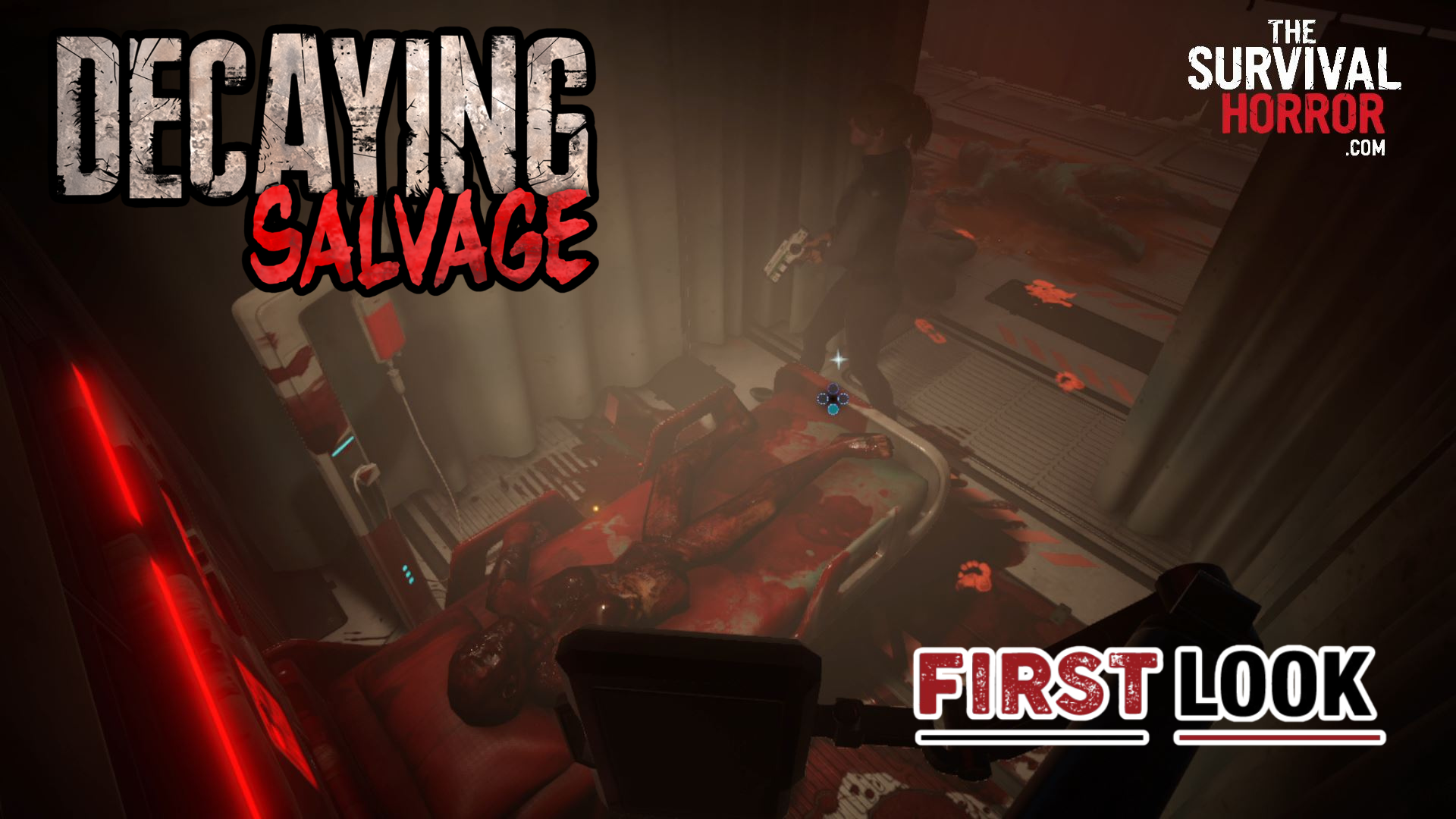
There is something incredibly satisfying about a survival horror game that understands that making the player uncomfortable is more important than making them powerful. And I say this with my heart in my hands because In an era where horror games increasingly give players enormous arsenals, cinematic action sequences and enemies designed to be destroyed rather than feared, Decaying Salvage feels like a deliberate step backward and I mean that as one of the highest compliments I can give a survival horror game.


Developed around the idea of bringing the classic survival horror formula into a science-fiction setting, Decaying Salvage is a modern survival horror experience built for players who miss fixed camera angles, puzzles, limited ammunition, inventory management, interconnected environments and, most importantly, that horrible feeling of wondering what is waiting behind the next door.
Thanks to Drewid for providing me with early access to the demo build. It genuinely means a lot when independent developers trust our platform enough to let us experience their games early. We spend so much time covering and supporting smaller developers, so getting the opportunity to see these projects before release is something we deeply appreciate. And after spending time with this demo, I can already say: We are so back!
Decaying Salvage is a Different Kind of Space Horror
The premise immediately caught my attention. Jordan’s ship is failing, and surrounding her is an impossible sight: a graveyard of abandoned starships. If she wants to make it back to Earth, she has no choice but to board them.


That setup gives Decaying Salvage an incredibly strong foundation for survival horror. Space is already terrifying. You have isolation. You have darkness. You have limited resources. You have nowhere to run. Now imagine being trapped inside a massive abandoned ship where you don’t know what happened to the crew, what is still alive, or whether the next room contains the component you desperately need to survive.
And here’s where I want to stop everyone before they immediately say: “So… Dead Space?” Hold your horses. Yes, the concept of survival horror in space naturally brings Dead Space to mind. But Decaying Salvage is approaching the idea from a completely different direction. Rather than turning the player into an increasingly powerful space marine, Decaying Salvage feels much closer to taking the classic Resident Evil survival horror formula and putting it inside a derelict spaceship. And for someone who absolutely loves that old-school design philosophy, that distinction is huge.
From First-Person Horror to Classic Survival Horror
One of the most interesting things about Decaying Salvage is that it wasn’t originally designed this way. The project began as a first-person horror game. A demo was created, a Steam page was established, and the original concept was taking shape. Then came the question: “What if I tried… That thought ultimately transformed the project.


Instead of becoming another first person indie horror game in an increasingly crowded market, Decaying Salvage became a third person, fixed camera survival horror experience while retaining the core ideas of the original project. And honestly? That decision may be one of the game’s greatest strengths.
I Am In Love With Decaying Salvage Camera Angles
The fixed cameras in Decaying Salvage are doing something I absolutely love: they are playing with perspective. These aren’t cameras that simply exist because the game wants to imitate an old survival horror title. The angles are deliberately positioned to make environments feel larger, stranger and sometimes more threatening than they actually are. A hallway can look completely different depending on where the camera is positioned. A doorway can become a visual trap. A room can reveal just enough information to make you question what you saw. And because the player doesn’t control the camera, the developer controls the information.


The camera isn’t just showing you the environment. It’s controlling what the environment allows you to know. And I am absolutely in love with the angles in this game. There was one particular moment where I could hear enemies in another room. My brain immediately started preparing for them to be standing right next to me. They weren’t. Genius! That uncertainty is exactly what fixed camera survival horror can create.
The Stalker Is Back in Decaying Salvaged? Confirmed!
Now let’s talk about one of the most important ingredients of classic survival horror: The stalker. You know the type. The enemy you don’t simply encounter. The enemy you can’t escape from. The tradition goes way back through horror, with the unstoppable killer archetype famously associated with characters like Jason Voorhees, before survival horror transformed that idea into some of gaming’s most memorable threats. Nemesis. Mr. X. Scissorman. Different characters. Different games. Different mechanics. But the same basic nightmare: Something is coming for you, and you can’t permanently get rid of it. We can’t experience this completely in the Demo but after asking the developer while chatting it was confirmed this scary guy right here will be indeed a Stalker! So Decaying Salvage also brings that tradition back.


And yes… The stalker is here. And he doesn’t stop. Even the demo ends in a very cool way! No Spoilers here!
The stalker changes the entire psychology of exploration. Normal enemies are problems you can potentially solve. A zombie blocking your path? You can shoot it. You can evade it. You can potentially clear the room. But a stalker? That’s different. You don’t necessarily get to make the problem disappear. I mean there are stalker hybrids like the Hunter but you know how that goes as well! You have to survive it. And that is exactly what makes the classic stalker enemy so effective.
Environmental Storytelling Is PEAK
Environmental storytelling is PEAK. This is probably one of the biggest things I want to highlight about the demo. The ship itself is telling you what happened. You don’t necessarily need a character standing in front of you explaining the entire history of the disaster. You can discover it. You can see what happened to the crew. You can find bodies. You can see people who were torn apart, You can see evidence of resistance, Evidence of struggle, Evidence that whatever happened aboard these ships wasn’t something the crew simply accepted. They fought. They tried to survive. And eventually, they lost. You can get all of this from just looking at the environment and exploring without opening a single note.


That creates an incredibly powerful question: What the hell happened here? And more importantly: What is happening to Jordan now? That’s the kind of storytelling I want from survival horror. Give me the pieces. Let me put them together. Don’t explain everything immediately. Let the environment make me uncomfortable before the story tells me why I should be uncomfortable. The abandoned ships become more than levels. They become crime scenes. Every room can contain evidence. Every body can tell a story. Every bloodstain can raise another question. Like Every note can provide another piece of the puzzle but this is exactly what makes exploration feel meaningful.
The Doors Are Doing Something Special
I didn’t expect to care this much about doors. But here we are. The door animations in Decaying Salvage are fantastic. Classic Resident Evil fans know exactly what the old door animation meant. You’d approach a door, interact with it, and suddenly the game would take control away from you. The door would open slowly. You’d hear the sound. You’d wait and wonder what was on the other side. Decaying Salvage somehow takes that same philosophy and reimagines it for an automated spaceship door.

Instead of simply recreating the classic creaking door, the game uses the technology of its setting to create the same tension. You hear the mechanisms. You hear the hiss and you can almost imagine the pressure systems adjusting, gases shifting and machinery working to open the door. And then… Silence. That silence is incredibly important. The game doesn’t need to throw a jump scare at you. It doesn’t need to blast music. It doesn’t need to scream at you. You hear the door mechanism. You hear the pressure release. And then there’s nothing. Just you. The ship. And whatever is waiting on the other side. Yeah bud! you’re screwed!


That is environmental horror at its best…
The Survival Horror Checklist Is Looking Pretty Damn Good
If you told me to make a checklist of everything I want from a traditional survival horror game, Decaying Salvage would already be checking boxes. Inventory management? Check. Scarce ammunition? Check. Backtracking? Check. Puzzles? Check. Locked doors? Check. Keycards? Check. Interconnected environments? Check.


But wait thats not all ! Save rooms? Check. A reliable pistol? Check. A shotgun for when things get really ugly? Absolutely. An unstoppable stalker hunting you through the ship? HELL YES. And yes… A knife. Because sometimes the knife is all you have.


Then Came the Shotgun Puzzle
This is probably the moment where I knew the developers understood exactly what kind of survival horror game they were making. There is a puzzle involving the shotgun that requires you to actually read the notes scattered throughout the environment. Yes. Read. The. Notes.
I have been talking about how much I miss this kind of design for years. The puzzle requires you to piece together information involving a patient list and moving a body through the ship from the morgue to the examination room. You eventually scan the body and dissect it to retrieve a severed arm.


And why do you need a severed arm? Because apparently some absolutely insane security employee decided that a shotgun and a human arm weigh the same according to a note. So you use the arm as part of the mechanism to retrieve the shotgun. GOD DAMN.


That is the kind of bizarre, environmental puzzle logic that makes classic survival horror memorable. It isn’t simply: Find key. Open door. Nope!


The environment itself becomes the puzzle. The documents provide information. The information gives you a solution. And the solution gives you access to another part of the ship. And that access gives you another resource. That is survival horror progression. Simple right? Not Really.
Scarcity Actually Matters
One of the most important elements of survival horror is resource management. If ammunition is everywhere, enemies stop being frightening. If healing items are everywhere, damage stops being meaningful. If you can carry everything, inventory management becomes irrelevant. Decaying Salvage understands that scarcity creates tension. Ammunition is limited. Supplies are limited. And enemies don’t always need to be killed. Sometimes you should fight. Sometimes you should run. And sometimes running is absolutely the correct decision.


That becomes particularly important when enemies start appearing in groups or in locations where your ability to maneuver is restricted. I learned that the hard way. Getting cornered is bad. Very bad. I died a couple of times because I underestimated how quickly an encounter could turn against me. And honestly? I loved it. Because dying, given that you made a bad survival decision feels very different from dying because a game simply threw an unfair enemy at you.

The Enemies Don’t All Play the Same
The demo introduces several different enemy behaviors and sizes, and that’s another promising aspect of the game. Get yourself trapped in a corner and suddenly that harmless-looking enemy becomes a serious threat. Then you have enemies that explode and inflict a poison status effect. And this isn’t just some annoying damage over time mechanic. The poison prevents you from running. That is a fantastic survival horror design choice. Think about it: You’re already trying to survive. You’re already conserving ammunition. You get poisoned. And now your ability to run away has been taken from you. risk and Reward Baby!


Suddenly every enemy around you becomes significantly more dangerous. It forces you to think about encounters instead of simply reacting to them. And yes, the exploding enemies immediately gave me a little bit of Left 4 Dead Bloater energy. But the mechanical consequence of the poison makes them particularly nasty in Decaying Salvage.
The Map Actually Helps
The map is one of the features I particularly appreciated. It doesn’t simply tell you where you are. It helps you understand what you’ve already explored. And I can’t stress you enough on how important it is for me a player that consistently looks at the map for direction. Different areas change color once you’ve essentially completed your exploration of that section. This is an excellent quality-of-life decision.

Because there is a massive difference between “I have to backtrack and “I have to backtrack but I have absolutely no idea where the hell I’m going.”
“Another Soul Lost to the Void”
When you die, the game gives you the message: “Another soul lost to the void.” I really like this. It feels like a more atmospheric and thematic interpretation of the traditional “You Died” screen.

You’re not simply a player who failed an encounter. You’re another person who has been consumed by this place. Another soul lost somewhere in the emptiness. It’s a small powerful detail. But survival horror is often built from small details.
The Horror of Being Trapped in Space
The setting gives Decaying Salvage something that classic survival horror traditionally doesn’t have: cosmic isolation. On Earth, there’s always the possibility that somebody is coming. A police station. A town. A hospital. A city. Somewhere outside the walls, civilization still exists.
In space? There may be nothing. Just darkness. And abandoned ships that inside may represent our humanity through medical areas, offices , lunch rooms and you know the usual…. but now take all of that away, Yep! i Know Faaaaack! right?
First Look Score: Promising ,
Decaying Salvage for sure will earn its place in The Vault !
Check Out our First Look Gameplay video!
Wishlist and Play the Demo on Steam!
Steam: Decaying Salvage on Steam
Leave a Reply